FUNDAMENTALS OF FOOD TECHNOLOGY #363 VALUABLE INSIGHT

I- PICKLING

Pickling is the process of preserving edible products in an acid solution, usually vinegar, or in salt solution (brine). In the latter case, the acid that does the preservative action (lactic acid mainly) is produced by fermentation. The process of pickling is also known as brining and the resulting foods as pickles.
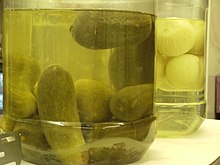
Pickling imparts unique characteristics to fruits and vegetables. Desirable changes in flavor, texture, and color take place in fermented, pasteurized, and refrigerated pickles, and are carefully monitored. However, some of the same bacteria involved in normal fermentation, such as the lactic-acid-formers, may cause spoilage if not destroyed. Selected pickling problems which may affect sensory quality

II- SANITATION

Proper sanitation is important not only from the general health point of view but it has a vital role to play in our individual and social life too. Sanitation is one of the basic determinants of quality of life and human development index. Good sanitary practices prevent contamination of water and soil and thereby prevent diseases. The concept of sanitation was, therefore, expanded to include personal hygiene, home sanitation, safe water, garbage disposal, excreta disposal and waste water disposal.

III-PERSONAL HYGIENE AND SANITARY FOOD HANDLING

Utensils, equipment and food contact surfaces must be kept in a clean and sanitary condition.

Food businesses must ensure eating and drinking utensils and food contact surfaces of equipment:
-are clean
-have had heat and/or chemicals, or other processes applied to them so that the number of microorganisms on the surface or utensil is reduced to a level that does not:
compromise the safety of the food with which it may come into contact
permit the transmission of infectious disease.

Meeting relevant legislation requirements for cleaning and maintenance is not only important for compliance reasons; it is also beneficial for the success of a food business.

Consumers are now increasingly aware of the requirements of food businesses and the processes needed to produce safe and suitable food.

Not only will consumers question poor food handling and hygiene practices, they are also more likely to return to clean, well maintained premises

IV- Cleaning compound

Cleaners are compounded specifically for performing certain jobs such as for washing floors and walls, use in a high-pressure washer, cleaning-in-place (CIP), and other purposes. Good cleaners must be economical, nontoxic, noncorrosive, non-caking, non-dusting, easy to measure or meter, stable during storage, and easily and completely dissolved. Cleaning compound requirements vary according to the area and equipment to be cleaned. The selection of compounds for blending, to form a satisfactory cleaner, requires specialized and technical knowledge. Major considerations in cleaning compound selection are the nature of the soil to be cleaned, water characteristics, application method, and area and kind of equipment to be cleaned.

The major function of cleaning compounds is to lower the surface tension of water so that soils may be loosened and flushed away. Detergent auxiliaries are included in cleaning compounds to protect sensitive surfaces or to improve the cleaning properties. Knowledge of how to handle cleaning compounds is essential to reduce the potential for injury of employees. If a worker is accidentally splashed with a cleaning compound, the affected area must be flushed with a large amount of water immediately.

Chapter VI – Sanitation Equipment

sanitization is the process of cleaning a specific area or surface so that it is bacteria-free and elementally clean for all sorts of microorganisms. The main goal of sanitizing in the food sector is to lower the rate of germs. In sanitation, physically or nutritionally eradicating microbial and cleaning microorganisms during cleaning may be sufficient to control microbial and cleaning microorganisms. In most cases, sanitizing chemicals and heat are used. In fact, sanitization can be done by hand or by machine.

Chapter VII – Waste Product Handling

Proper handling of waste product is important to avoid contamination most especially when the waste is hazard and in need for proper disposal. Individual should exercise waste avoidance. They can recycle old items, repair broken items, donating items that are not being used.


Marriage & family relationship 383 . Valuable insight In every chapter in this Subject.

Chapter I. STUDY OF THE FAMILY

We study families in order to better understand ourselves. When we can see our own family within the greater context of the experiences of other families and societal influences and trends, we understand ourselves better. Being able to relate your own experiences to these greater forces and interactions with the world is called the sociological imagination.

We also study families in order to better understand other families and society. In this way we recognize both the uniqueness of each family and the ways in which groups share identities and experiences. Let’s say that you feel familiar with the experience of a rural student family, because you are a student and you live in a rural community. You may be able to speak very eloquently to the challenges students are facing today, and what living in a rural setting means about your access to education, medical care, healthy food, and transportation. At the same time, you cannot speak for all rural student families, because every family has a unique history and set of circumstances that also affects their lives. So part of your job in studying families is to listen and understand how those other rural student families experience life, what their strengths are, and what they need.We study families to make a difference in our everyday lives: to better understand our own families, our neighbors, and our friends. Studying families also helps us in our work lives. All of us will work with a diverse group of individuals, all of whom have families. Whether you are a teacher who influences the next generation, a business owner who coordinates benefits for your employees, a marketing director who designs advertising campaigns, a computer programmer who creates code, or a social worker who helps people solve life problems, you will both work alongside a group of diverse individuals who have families, and you will have clients, consumers, or customers who are members of this diverse country,

II. FAMILY AND KINSHIP STRUCTURE

As a unit of socialization, the family is an object of analysis for sociologists, and is considered to be the agency of primary socialization.
A conjugal family includes only the husband, wife, and unmarried children who are not of age. This is also referred to as a nuclear family.
Consanguinity is defined as the property of belonging to the same kinship as another person.
A matrilocal family consists of a mother and her children, independent of a father. This occurs in cases when the mother has the resources to independently rear children, or in societies where males are mobile and rarely at home.
The model of the family triangle, husband-wife-children isolated from the outside, is also called the Oedipal model of the family and it is a form of patriarchal family.
A matrilocal family consists of a mother and her children.
The model, common in the western societies, of the family triangle, husband-wife-children isolated from the outside, is also called the Oedipal model of the family and it is a form of patriarchal family.

III – FUNCTION OF THE FAMILY AND KIN GROUP

The institutions of the family and marriage are found in all societies and are part of cultural understandings of the way the world should work. In all cultures there are variations that are acceptable as well as situations in which people cannot quite meet the ideal. How people construct families varies greatly from one society to another, but there are patterns across cultures that are linked to economics, religion, and other cultural and environmental factors. The study of families and marriage is an important part of anthropology because family and household groups play a central role in defining relationships between people and making society function. While there is nothing in biology that dictates that a family group be organized in a particular way, our cultural expectations leads to ideas about families that seem “natural” to us. As cultures change over time, ideas about family also adapt to new circumstances.

IV- COURTSHIP AND MARRIAGE PATTERN

Courtship is used by a number of theorists to explain gendering processes and sexual identity. Despite occasional studies as early as the 1910’s, systematic scientific research into courtship began in the 1980s after which time academic researchers started to generate theories about modern dating practices and norms. Both Moore and Perper argued that, contrary to popular beliefs, courtship is normally triggered and controlled by women, driven mainly by non-verbal behaviors to which men respond.

V- MATE SELECTION

Mate selection is the process of choosing a partner with whom to form a marriage bond or long-term marriage-like relationship. While personal preference is a key component in the selection process, structural influences also exist. Among the explanations for mate choice are filter theories, social exchange, sociobiology, needs and values, and matching hypotheses. Studies in the sociological literature emphasize life course factors and variations by gender, race, class, culture, and specific personal traits. As the role of marriage in western culture changes, so do the goals of mate selection. Internet sites offer new opportunities for daters and for researchers.

VI-HUSBAND AND WIFE ROLES

Behind every successful man is a woman. And if the man is married, then the woman is definitely his wife.

The role of a wife is so crucial that she can either make or break a family. She gives her husband the strength to succeed, she nurtures her children to stay healthy and do well in their life, and she has the ability to take care of every minute detail at home.

Marriage becomes a beautiful journey when you provide for, nurture, and complement each other and when the husband reciprocates wife’s approach. As a wife, you might want to give it your best shot while maintaining your dignity and self-respect.

VII- MARITAL POWER AND DECISION MAKING

Background, personality, and couple-related variables as possible explanations for marital roles in purchase decision making are explored for both wives and husbands. Marital roles in decisions reflecting various levels of purchasing involvement were related to component-score variables through discriminant function analysis. The most important factor for wives in determining the role structure for high-involvement purchases is modernity in sex-role orientation, whereas for husbands, the most powerful determinant is confidence in spouse. For both wives and husbands, the confidence in spouse factor is most important in determining relative influence for low-involvement purchases.

VIII- ADJUSTMENT IN MARRIAGE

All married couples go through periods of adjustment. Adjusting to marriage involves uniting two sets of perceptions, expectations, needs, goals, and personalities.

Strong marriages are the result of efforts by both spouses to make the marriage work.

Couple relationships that survive and continue to deepen are generally happy, always adjusting, and always under construction. Marriage has both highs and lows, and accepting this as “normal” will help the couple have more realistic expectations.

A strong partnership provides companionship, interpersonal closeness, emotional fulfillment, and support that acts as a buffer against physical and emotional affliction. Marriage should enrich the love between two people, and it evolves through the foundations of friendship, a meaningful sexual relationship, mutual respect, trust, and compassion.

Strong marriages do not happen quickly or easily. Building a strong marriage takes time, effort, and commitment.

CHAPTER IX (PARENTHOOD)

Good parenting entails taking good care of one’s children and ensuring that they grow up in a safe and happy environment, are well educated, and understand right from wrong. Parenthood is crucial in a variety of ways. Nurturing relationships provides assets and capacity as to areas of durability, proliferation, nurturance, and socializing throughout generational gatherings. Whatever parenting style parents choose, the goal of nurturing is to develop a teenager who is healthy and effective in everyday life, who can contribute to self and society, and who recognizes and works to meet social needs. Socialization refers to the interaction – the techniques that are used throughout time to achieve these goals.

Fundamentals of food technology 363.Activity p#3


Smoked fish or tinapa is a style of fish preservation wherein the fish are cured by smoking. The smoking of fish is generally done for the unique taste and flavour imparted by the smoking process.


Materials:


1 kilo tamban or galunggong
Salt

Utensils:

Kitchen knife
Smoking trays
Tin cans

Procedure:

1. Cut the fish along the back just above the backbone to split it open leaving the belly solid.
2. Remove all internal organs and blood.
3. Make another cut under the backbone.
4. Wash well and soak for 30 minutes in a solution of 1/2 cup salt and 4 cups water.
5. Place the fish in a coarsely woven basket and dip in boiling 10% salt solution (approximately 6 tbsp salt for every 4 cups water until he eyes turn white)
6. Arrange fish in smoking trays and drain for 10 minutes.
7. Partially dry fish in cool, shady place for about 3 hours before smoking.
8. Smoke fish at 32-38oC for 1-2 hours or until golden brown in color.
9. Cool smoked fish for a while and brush with vegetable oil.

Because of its unique taste, making smoked fish or tinapa at home is also an ideal business to start. You can make different variants of smoked fish.

Cook’s Notes
Fish can be brined overnight for a deeper flavor. Pickled onions, tomatoes, capers, sour cream, and cream cheese all pair beautifully with smoked fish

Fundamentals Of Food Technology 363 activity #2 drying preservation technique

How to dry strawberries at home

When preserving strawberries, most people freeze them or make strawberry jam, but another alternative is drying. Dried strawberries can be eaten as a snack, added to green salads, cooked and dried cereals, muffins, pancakes, cookie dough, or smoothies, combined with granola or mixed with ice cream or yogurt.

Directions;
Select sweet berries that are firm, ripe and have a good solid color.
Wash berries, remove caps and cut into 1/2″ slices. You can also cut them in half lengthwise.
Dry cut-side up at 130 to 140 degrees F. Use a dehydrator or dry in an oven if you are able to set the oven temperature low enough.
Drying time depends on the size of the berry pieces, exposure to air to cut surfaces, temperature, air circulation and method of drying.
7 to 15 hours for slices.
24 to 36 hours for whole berries.
Dried strawberries should be pliable and leathery with no bits of moisture.
After drying, cool fruit for 30 minutes.
Store in an air-tight or vacuum-sealed container. For longer storage, freeze.

Marriage &Family Relationship 383 activity #2

THE PROCESS OF GETTING MARRIED IN THE PHILIPPINES
we think about marriage, the first thing that comes to our mind is the long-lasting relationship. Also, marriage is one of the most important decisions in our life. Because we are choosing to live our whole life with that one person.
Here’s what you need to know and what documents to bring with you getting married in the Philippines;


Required Documents and Information
If this is your first marriage, the local civil registrar will ask to see your original birth certificates or your baptismal certificates. Certified copies may be accepted. You need to provide the full name, residence, and citizenship of your parents or guardians.

If either of you is not a citizen of the Philippines, you have to provide your passport and a certificate of legal capacity to contract marriage. An affidavit in lieu of the certificate may also be accepted. You need to check with a U.S. consular officer to make sure they are providing the affidavit.

Age Requirements, Parental Consent, and Parental Advice
If you are under the age of 18, you cannot get married in the Philippines even if your parents are OK with the marriage.

Individuals must be at least 21 years old to get married in the Philippines without written parental consent. If your parents cannot appear with you before the local civil registrar, a legal affidavit with the signatures of two witnesses may be accepted.Individuals between the age of 21 and 25, must “… ask their parents or guardian for advice upon the intended marriage. If they do not obtain such advice, or if it is unfavorable, the marriage license shall not be issued until after three months following the completion of the publication of the application therefor. A sworn statement by the contracting parties to the effect that such advice has been sought, together with the written advice given, if any, shall be attached to the application for a marriage license. Should the parents or guardian refuse to give any advice, this fact shall be stated in the sworn statement.”

Waiting Period
There is a waiting period of 10 consecutive days while notice of the marriage application is posted on a bulletin board outside the local civil registrar’s office.
Fees
Check with the local civil registrar for the fees charged for a marriage license. Fees for a marriage license may be waived if the couple applying has no visible means of income or has insufficient income.


Pre-Marital Counseling and Family Planning Seminar
If either of you is between the ages of 18 and 25, you will need to show proof to the local civil registrar that you have received marriage counseling. If you do not receive marriage counseling, your marriage license will not be issued for three months.
Previous Marriages
If you have been previously married, you will need to provide the death certificate of your deceased spouse or the judicial decree of your absolute divorce or the judicial decree of your annulment or declaration of nullity of your previous marriage.

Witnesses
Two witnesses are required. Witnesses must be of legal age.

Officiants
Members of the local judiciary; priests, rabbis, imams, ministers of registered churches or religious sects; consul generals, consuls, vice-consuls. Military commanders in the absence of a chaplain and ship captains and airplane chiefs can solemnize a marriage in articulo mortis.
If you use a religious officiant, one of you must belong to the officiant’s church or religious sect.
Wedding Locations
Marriages must be solemnized publicly in a church, chapel, temple, judicial chambers or offices of consuls. The only time a wedding can take place elsewhere is if the wedding is articulo mortis, in a remote location, or if the officiant receives a request for a different location.

Proxy Marriage
The Republic of The Philippines does not allow marriage by proxy.

Common-Law Marriage
The Family Code of The Republic of The Philippines states: “No license shall be necessary for the marriage of a man and a woman who have lived together as husband and wife for at least five years and without any legal impediment to marry each other. The contracting parties shall state the foregoing facts in an affidavit before any person authorized by law to administer oaths. The solemnizing officer shall also state under oath that he ascertained the qualifications of the contracting parties are found no legal impediment to the marriage. (76a)”
Cousin Marriages
Cousin marriages are not allowed. “Section 1, Article 38 of the Family Code prohibits marriage of relatives up to the fourth civil degree (first cousins).”
Miscellaneous
The marriage license in the Philippines is valid for 120 days from the date of issue.
– the SPRUCE.com

I can say that Each couple may celebrate their marriage in their own way and style. But always Remember to take care of the official matters related to getting married. Because marriage represents a multi-level commitment, ,and a relatively permanent bond.